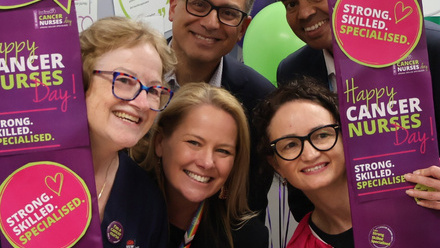
Media Release | Australia celebrates the Strong, Skilled and Specialised cancer nurses at the heart of cancer care.
Now in its third year, Cancer Nurses Day brings healthcare organisations, cancer nurses and communities across Australia together to celebrate the profession and increase awareness of the specialist expertise behind cancer care.
Cancer nurses are the largest health professional group within Australia’s cancer workforce. They work across prevention, diagnosis, treatment, survivorship, supportive care and end-of-life care, providing expert clinical care, coordination, education and advocacy for people affected by cancer and their carers. Cancer nursing demands specialist knowledge, advanced clinical judgement, leadership and compassion.
CNSA President Professor Gemma McErlean said cancer nurses should be recognised not only for the support they provide, but also for their direct contribution to patient safety, experiences and outcomes.
“Cancer nurses are strong advocates, highly skilled clinicians and specialised healthcare professionals. Their expertise, clinical judgement and coordination directly influence how safely and effectively people move through cancer diagnosis, treatment, survivorship, supportive care and end-of-life care.”
Building the evidence for a stronger cancer nursing workforce
This Cancer Nurses Day, CNSA is also highlighting two key initiatives that will help strengthen and support Australia's cancer nursing workforce: the release of findings from the 2025 National Cancer Nursing Workforce Survey and the Australian Cancer Nursing Capability Framework (AusCaN).
The 2025 Cancer Nursing Survey was completed by almost 1,000 nurses across all states and territories, metropolitan, regional, rural and remote healthcare settings.2 It provides an important national snapshot of the cancer nursing workforce, where nurses work, the pressures they are experiencing, their aspirations for specialist and advanced practice, and what is needed to retain and strengthen the profession.
The findings demonstrate a highly motivated workforce committed to undertaking specialist and advanced practice training,working to optimal scope of practice, and delivering high-quality person-centred cancer care. They also point to increasing pressure from rising demand for cancer services, greater complexity of care and persistent recruitment and retention challenges. These issues require urgent attention if Australian is to sustain a skilled and specialised cancer nursing workforce into the future.
CNSA will continue to use this workforce data to support our advocacy for improved access to educational opportunities that enable nurses to undertake advanced practice roles, investment in nurse-led models of care that enable the delivery of high-quality care for all communities affected by cancer, and health system workforce and succession planning that address current supply and demand issues.
Professor McErlean said the survey would provide an essential evidence base for future workforce policy and investment.
“Effective workforce planning must begin with reliable information. This survey allows cancer nurses to describe their profession in their own voices:their capabilities, working environments, pressures, aspirations and the changes needed to sustain the workforce. This evidence will strengthen our advocacy for investment, education, advanced practice, retention, succession planning, regional and rural access, and the recognition of cancer nursing as a specialist profession.”
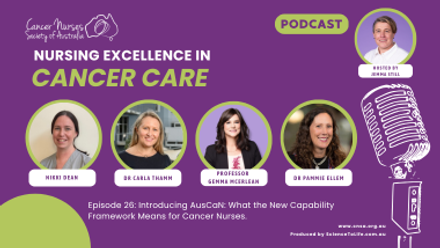
CNSA also recently launched the Australian Cancer Nursing Capability Framework (AusCaN).3 This framework describes the knowledge, skills and professional capabilities required across different levels of cancer nursing practice, from foundational through to specialised and advanced practice, to support safe, equitable and person-centred cancer care.
The framework supports nurses to identify their development needs and plan their careers. It also helps educators, managers and healthcare organisations establish clearer roles, education pathways and workforce development strategies.
Professor McErlean said AusCaN provides a common language for recognising and developing the capabilities of nurses working with people affected by cancer.
“Cancer nursing is not a single role or a single level of practice. It includes nurses developing essential cancer care capabilities, specialist cancer nurses, and nurses working in advanced and extended roles. AusCaN makes that progression visible. It helps nurses understand where they are, where they can develop and what support they need to provide increasingly complex cancer care.”
Recognition must be matched by action
Despite their contribution, cancer nurses are not always recognised in workforce planning, career structures, funding arrangements or healthcare policy.
CNSA is calling for:
- sustained investment in specialist cancer nursing positions and nurse-led models of care;
- workforce planning informed by national cancer nursing data;
- support for cancer nurses to work to their full scope of practice;
- strong representation of cancer nurses in policy, service design and healthcare decision-making; and
- equitable access to cancer nursing expertise regardless of location, cancer type or treatment setting.
Professor McErlean said recognition must extend beyond celebrating the compassion of cancer nurses.
“Recognition must be matched by action. Cancer nurses need appropriate education, defined career pathways, opportunities to work to their optimal scope of practice, and a meaningful voice in the design of cancer services and health policy.”
This Cancer Nurses Day, CNSA is encouraging healthcare organisations and communities across Australia to celebrate the cancer nurses who are strong in support, skilled in practice and specialised in knowledge, and to recognise the vital role they play in delivering high-quality cancer care every day.
“Today, we ask every Australian whose life has been touched by cancer to recognise the cancer nurses who stand beside people and families throughout cancer care, providing specialist expertise, trusted guidance, reassurance and hope”
Professor McErlean said.
- END -
About the Cancer Nurses Society of Australia
The Cancer Nurses Society of Australia is the peak professional body representing more than 8,200 cancer nurses and over 2,200 CNSA members across Australia. CNSA supports, represents and advocates for cancer nurses working across all levels of cancer care. It promotes excellence in cancer nursing practice, education, research, leadership and policy, to achieve the best possible outcomes and experiences for all people affected by cancer.
Media contact:
Jemma Still
CEO, Cancer Nurses Society of Australia
[email protected]
0424 540 566
Notes for editors:
- Cancer Nurses Day is being held on 13th August, as an annual national opportunity to recognise and celebrate the expertise, leadership and impact of cancer nurses
- 2026 represents the third year of celebrating Cancer Nurses Day and continues the theme of Strong. Skilled and Specialised.
- There are around 8,200 cancer nurses in Australia who provide care across diagnosis, treatment, survivorship, supportive care and end-of life care and contribute to education, research, service improvement and advocacy.1
- The CNSA 2025 Cancer Nursing Workforce Survey was completed by almost 1,000 nurses working across Australian jurisdictions, geographic locations, clinical settings and models of care.
- The Australian Cancer Nursing Capability Framework (AusCaN) is a shared national standard for the cancer nursing workforce, supporting every nurse to deliver their best. Designed as a practical, accessible and aspirational resource, the framework supports professional growth, career development, workforce planning and the design of education programs.
References
- Commonwealth of Australia. National Health Workforce Dataset (NHWDS). Available at: https://hwd.health.gov.au/resources/information/nhwds.html
- Cancer Nurses Society of Australia. Australian Cancer Nursing Capability Framework. First edition. 2026. Available at: https://www.cnsa.org.au/implement/auscan.html
- Cancer Nurses Society of Australia. Cancer Nursing Workforce Survey 2025. [Unpublished raw data]