CNSA Research Grant Recipient: Meet Kerrie Curtis and find out more about her project
Tell us briefly about yourself and your current role in cancer care.
I always feel a bit ancient saying I’ve been a cancer nurse for 35 years — but I’m just as motivated and engaged as when I first started!
In my first year post-PhD, I’m juggling a wonderfully diverse portfolio: working clinically at Austin Health, leading two research studies, developing postgraduate vascular access content at the University of Wollongong, and working as a casual academic at the University of Melbourne. Cancer care — and particularly vascular access — continues to be at the heart of everything I do.
In simple terms, what is your research project about and what problem are you trying to address?
For anyone who knows me, it’s no secret I’m passionate about vascular access.
We’re increasingly recognising the long-term impact of the traditional approach to IV insertion practice ― with multiple attempts and persevering with IVs until the patient has no peripheral veins left ― and, importantly, we are listening to patients who describe these experiences as distressing, traumatising and painful.
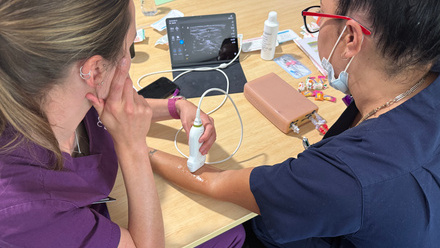
Evidence shows that when cancer nurses work to their full scope of practice, including using ultrasound to assess veins and guide insertion, first insertion success improves significantly. Yet in Australia, we don’t actually know how many cancer patients are affected by DIVA.
Our multisite, binational point prevalence study across regional and metropolitan centres in Australia and New Zealand aims to change that. By identifying and quantifying DIVA in patients attending day therapy and ambulatory cancer units, we will generate the first clear snapshot of the scale of this issue in our local setting.
This research will provide critical data to support trail-blazing health services that are investing in nurse-led ultrasound-guided PIVC insertion. Ultimately, the goal is simple: fewer painful attempts, better patient experiences, and smarter, evidence-based vascular access care.
Why is this issue important for patients, families, or the cancer nursing workforce right now?
This issue matters on every level.
For patients and families, repeated IV attempts can be painful, distressing and, at times, traumatising. They contribute to delayed treatment and discharge, and erode confidence in care. That experience must change.
For the cancer nursing workforce, multiple insertion attempts are time-consuming and stressful. They contribute to chair blocks in day units, delayed treatments, workflow disruption and increased pressure on already stretched teams.
At a health service level, repeated attempts are resource-intensive — increasing supply use, staff time and overall costs. Improving first-attempt success isn’t just about technical skill; it’s about patient experience, workforce sustainability and responsible use of healthcare resources.
What difference do you hope your project will make to practice, patient experience, or outcomes?
We aim to shine a light on the scale of DIVA within the Australian and New Zealand context — because meaningful change starts with understanding the problem.
By identifying how many patients are affected, we hope to provide the evidence needed to drive practice change, support nurse-led ultrasound-guided PIVC insertion, and inform workforce capability development.
Ultimately, the difference we want to see is simple but powerful: fewer failed attempts, less patient distress, more efficient care delivery, and better outcomes for people receiving cancer treatment.
Looking ahead, what do you see as key priorities for the future of cancer nursing, and how does research play a role?
Cancer nurses are central to shaping the future of patient-centred cancer care. We are uniquely positioned alongside patients and families across the entire cancer trajectory, giving us deep insight into what truly matters to them — and where the gaps and shortcomings in care exist.
Looking ahead, key priorities must include strengthening nurse-led models of care, working to full scope of practice, embedding evidence-based innovation, and ensuring workforce sustainability. Research is fundamental to this. It provides the evidence to challenge outdated practices, inform policy, and justify new models of care that improve both patient experience and clinical outcomes.
When cancer nurses lead and engage in research, we don’t just contribute to knowledge — we actively shape safer, smarter, more compassionate care for the future.
What does receiving a CNSA research grant mean to you, and what advice would you give to other cancer nurses considering research?
I am both honoured and humbled to receive the 2026 CNSA Research Grant. For a long time, I saw it as something unattainable — as though you had to lead a complex, randomised controlled trial to be worthy. What I’ve come to realise is that the scope and impact of research are as diverse as cancer nursing itself. I’m a cancer nurse with a vision to improve care — and that is enough to start.
To other cancer nurses considering research, my advice is: start small, ask why and be tenacious. What interests you? What frustrates you? What do you notice that doesn’t quite make sense? Talk to your team. Engage with colleagues. Consider further study. Find a gap. Ask, “Why is this happening?” or “Why do we do it this way?”
Research doesn’t have to be daunting. It becomes more engaging and motivating as you deepen your expertise in an area you care about. I never imagined I would pursue research — but if this is what research looks like, I’m hooked.